
NRS Boundary 100 Review (And How It Compares to a Water Master Kodiak)
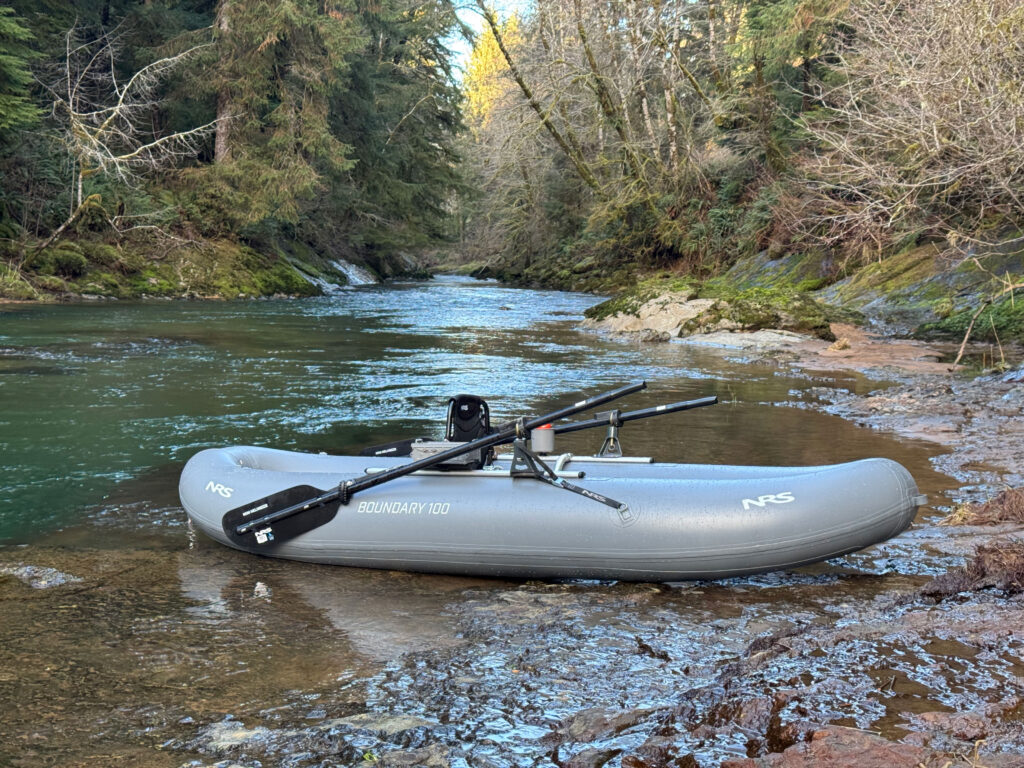
I have been a die hard Water Master Kodiak champion for the last 10+ years (after all, it is arguably the industry standard). The raft has been recommended to, and purchased by, many of my fishing partners. I have taken it across state lines to float some of the famed western rivers, as well as kicked across desert lakes in search of football shaped trout. Until recently, nothing came close to comparing with the Water Master – in fact, I have both the Kodiak and its little brother, the Grizzly.
After reading a handful of reviews on the NRS Boundary 100, most notably Dave McCoy’s (owner of Emerald Water Anglers) post about the new NRS raft, especially in regards to safety, my curiosity was piqued.
“When I look at small watercraft for river use, the first thing I look for is thoughtful design for efficiency of movement which leads to a safer watercraft.
This new @nrsweb Boundary 100 is as good as it gets in this category for a number of reasons. Oar, seat and foot adjustment, D-ring placement, oars, blades and locks among them.
If you are putting a boat with no rocker in moving water you have already compromised your safety and efficiency on the water.”
I’m not one to push the limits, but I have had a couple situations where my nerves were shaken. If there is a way to be safer on the water, I am all ears. Coming into salmon and steelhead season, and knowing where I would spend the majority of my time in the upcoming months, I decided it was time to check out the new NRS Boundary 100.
As someone who spends a fair amount of time researching gear and reading reviews, I tend to key in on the details. What makes [insert piece of gear here] better than the old version? Is it better than what else is out there? When personally comparing the NRS Boundary 100 to the Water Master Kodiak, here are my thoughts.
Size and Specs
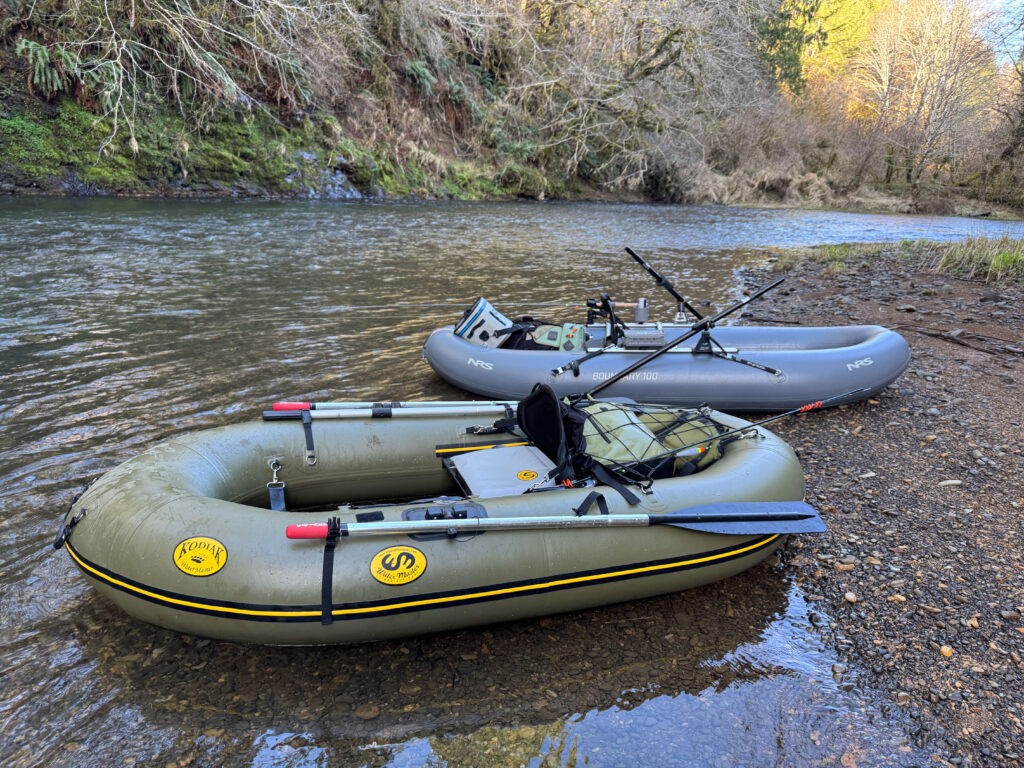
| The NRS Boundary 100 | Water Master Kodiak |
| Weight: 50lbs Length: 10’Width: 49” Price: $2495 | Weight: 42lbs Length: 8’ 10”Width: 52” Price: $1995 ($2,345 Expedition Package) |
The NRS Boundary is notably bigger, and dare I say a little more awkward. It almost feels like you need two people to pick up and move. One thing that I really like about the Water Master is that there are handles right by the seat. It is really easy to row to the river’s edge, grab the handles, stand up, and set the raft down where the current won’t take it down river. That is a little tougher to do with the Boundary. Without adding extra D-rings/handles, you need to awkwardly grab the frame.
Despite their size differences, both rafts weigh in under 50lbs and bringing them on the plane for a destination fishing trip shouldn’t be an issue.
What Else is in the Box?
Both boats come with pumps. The NRS Boundary arrived with the powerful Super 2 HP pump (with a pressure gauge!), while the Water Master comes with a packable foot pump. Again, Water Master has packability in mind. The foot pump stores nicely in the included dry bag. The Super 2 HP pump is pretty large and demands for its own space.
The YakAttack storage box that comes with the NRS Boundary is a bit disappointing. NRS advertises the “YakAttack x NRS TracPak Storage Box securely mounts to Slot Rail and provides convenient storage for flies, tools and more”, it would be better if the storage box also served as a dry box – somewhere to keep your phone and other items dry. Swing and a miss.
The Water Master Kodiak impressed me with the accessories that came in the box. When I got mine, I ordered the “Expedition Package”. In fact, I don’t know anyone who hasn’t ordered that package – the addition of the upgraded oars and the PVC zipper bag/drink holder are worth the extra money alone. However, go ahead and recycle the rod holder and get yourself a Scotty holder. The Boundary does not come with a rod holder, so you’ll need to buy the YakAttack Omega Pro rod holder separately.
The backpack style dry bag that comes with the Water Master really stands out. I am able to store my boat, pump, oars, life jacket, and all accessories in the bag. The NRS Boundary doesn’t come with a bag. And if it did, it would be a pretty big challenge to fit so many large components in it. I’m still figuring out the best way to keep everything together.
Also Add to the Cart
To really outfit either boat, there are some accessories that you should go ahead and add to your cart before you hit “Check Out”. I don’t know anyone who spends time on the water without a beverage. For the Boundary, NRS has partnered with YakAttack to offer the MultiMount Cup Holder. This slides right into the frame system and is wide enough to hold a water bottle, not just a can of your favorite barley pop.
As mentioned above, with the Boundary, you’ll want a YakAttack Omega Pro rod holder. Again, this slides right into the the track on the frame.
Finally, if you do any still water fishing, or are daring enough to wear them on a river (safety hazard alert), you’ll want a set of flippers. While they come with the Water Master Kodiak Expedition Package, you’ll need to source them separately for the NRS Boundary.
Function
Oar Locks
Regardless of the details, how do the NRS Boundary and Water Master compare when on the river? This is where the NRS Boundary got my attention. First, what most boats have struggled with over the years is the oar lock situation and this is an area where the Boundary really shines. Legit oar locks and towers slide into the frame (which is strapped down, like on a typical raft). I have been on rivers, trying to grab water with my oars, in my Water Master, and I can tell rowing isn’t as smooth as it should be – the oar locks are glued to the raft. When you really give it the business, the boat absorbs a lot of the energy.
Oars
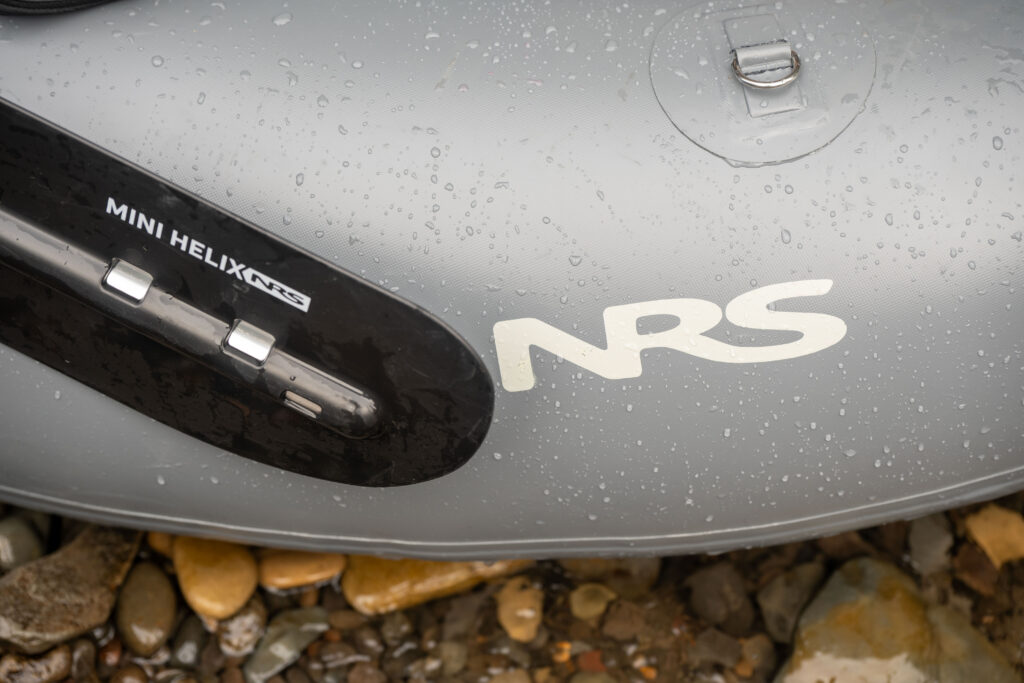
The “standard” oars that come with the Boundary and the Water Master are worlds apart. Even with the “upgraded” Crooked Creek Heavy Duty oars (an additional $180 upgrade), the Boundary oars are still better. Whereas the Water Master oars have a hole drilled in them to slide into the “pin” style oar lock, the NRS Advantage LT oar shafts and Mini Helix blades slide into the oar locks like they would on any raft. If you like the feel of having a “pin” style feel, you can purchase a set of “small” Oar Rights. The only downside with the NRS oars is that because they only break down where the shaft meets the blade, they are larger to transport. The Water Master oars break in half, making them very portable – and will fit inside the supplied dry bag – perfect for walk-in destinations.
Rack
Central to the NRS Boundary is the rack that straps on with 4 NRS straps. There is definitely a weight and portability trade off by adding a rack to your boat. While a Water Master is able to pack neatly into the dry bag that it comes with, you’ll have to resort to hauling the Boundary in on a wagon or park close enough to the water that you don’t need to transport the raft. While I am sure that someone out there will spend the time to assemble/disassemble the frame and put everything in a dry bag, I am unapologetically not that guy.
However, the platform provides a solid foundation for oars, rod holders, drink holders, etc, ultimately providing a better experience once you are on the water.
Rocker
If you are unfamiliar with the term “rocker”, it refers to the curved profile of the bottom of the raft – essentially how much the raft curves upward at the bow (front) and stern (back). By adding a rocker, the NRS Boundary has improved maneuverability, responsive handling, and better performance. The curved profile helps the raft ride over waves and hydraulics rather than plowing through them. The upturned ends can punch through standing waves more effectively and help the raft pop up and over river features.
The trade-off is that more rocker typically means less tracking (straight-line stability) in flat water and potentially less cargo space (though the extra foot in the Boundary provides more cargo storage in the back than the Water Master). While I have taken the Water Master down rivers that splash me in the face, the lack of rocker makes it better suited for still water.
Durability
Somehow I missed reading this in the specs of the NRS Boundary, but there is a second layer of wear/patch material on the bottom of the boat and on the top under the frame. While I know this adds additional weight, it is welcome, especially during those dry winter months when your raft is scraping bottom or you have to “send it” down primitive river bank launches.
I typically baby my gear pretty heavily. While I haven’t had to patch my Water Master, there are some scrapes that have shaved off some of the olive PVC coating. Since the NRS Boundary is new, time will tell how “bomb proof” it will be. If it is just as tough as NRS’s white water rafts, there won’t be anything to worry about.
Both the Water Master and NRS boundary are made out of PVC and have welded seams.
Seat
Neither the NRS Boundary or the Water Master are going to win awards for their seats. While the Boundary has a mesh folded seat back, the seat itself is a SeaDek type material. Regardless of the boat, I would recommend a close cell foam pad that is cut to the size of the seat. If you are really feeling like going all out, secure it down with some Velcro.
Would Be Nice to See
While the Boundary is the first personal fishing raft from NRS, I get the feeling that they started with the full sized raft mindset and worked into a personal raft, rather than take a good look at what is in the market and what to include/how to improve on it. For instance, there are straps on the Water Master to lash down a spare oar (which can also be broken in half). Having seen oars snapped or bent on floats, I always make sure someone in my fishing party is carrying an extra oar. I wish the Boundary’s design included a place for a spare oar.
Closing Thoughts
One isn’t a replacement for the other. Which one you chose will come down to how important the strengths and weaknesses of each are to your personal needs. When I bought the NRS Boundary 100, I went into it thinking it would be a replacement for the Water Master Kodiak. I don’t think that is the case anymore – they each have their place. Walk-ins and lakes? I’m still gonna pack my Water Master. River floats? 100% NRS Boundary. However, with that said, either one is up to the task at whatever water you put it on. They each shine in different scenarios.
Any questions? Let me know!